
SECURITY-
MINDED DEV
I’m a Computer Science student at the University of Calgary, concentrating in cybersecurity — what pulls me in is how systems break, and how to defend them. My foundation runs low: C and ARMv8 assembly, computer architecture, networked applications in Java, up through Python and JavaScript on the web. I’ve built encrypted applications with real cryptography — AES-GCM, Diffie-Hellman key exchange — shipped full website builds for real clients, and I’ve earned my CompTIA Security+ certification. I like problems that need both a strategic view and hands-on execution — the kind where you have to understand every layer to secure it — and I care about the details most people skip past.
SELECTED WORK
A full rebuild of the café’s web presence. I designed the layout and visual direction, built the front end from scratch in HTML/CSS/JS, and deployed to Cloudflare Pages for fast edge delivery. Worked directly with the owner to translate business needs — menu, hours, location, brand feel — into a clean, fast, mobile-first site.

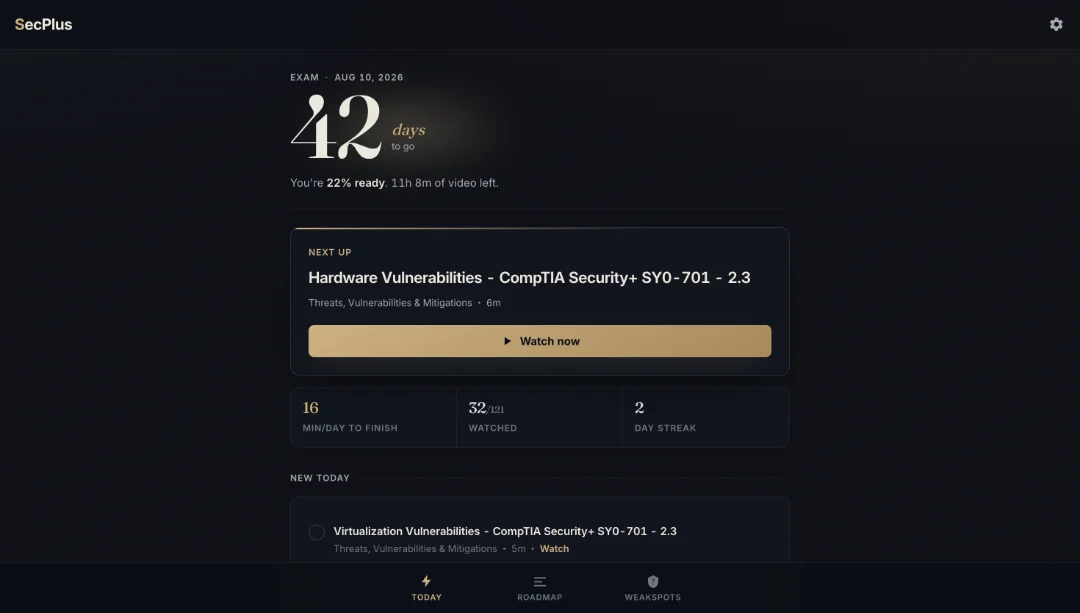
A self-hosted progressive web app I built to run my own Security+ prep: spaced-repetition review of exam objectives, a roadmap tracker across the certification domains, and cloud sync via Firebase so progress follows me across devices. Installable, offline-capable, and tuned for daily study.
The site you’re on, live at daisecurity.dev. A brutalist Swiss-editorial portfolio — oversized display type, a monospace HUD, a decrypting-signal hero, and scroll-driven reveals. I shaped the design direction with Claude’s design help and built it out with Base44, then deployed it as a static site. Full disclosure: the site’s own security still needs a lot of improvement — hardening it (security headers, best practices, and the rest) is an ongoing learning project.
Working through TryHackMe’s SOC Level 1 path — practical blue-team rooms covering security monitoring, SIEM log analysis, network traffic analysis, cyber threat intelligence, endpoint security, and the incident-response process. It reinforces the Security+ fundamentals with hands-on detection: reading alerts, investigating indicators of compromise, and triaging events like a tier-1 SOC analyst.
VIEW PATH ↗A home lab I’m setting up to build defensive skills hands-on: a segmented virtual network, centralized log collection and monitoring (SIEM), and detection engineering against simulated attacks. The goal is to turn coursework and certifications into practical, repeatable defense — building, breaking, and detecting in an environment I fully control.